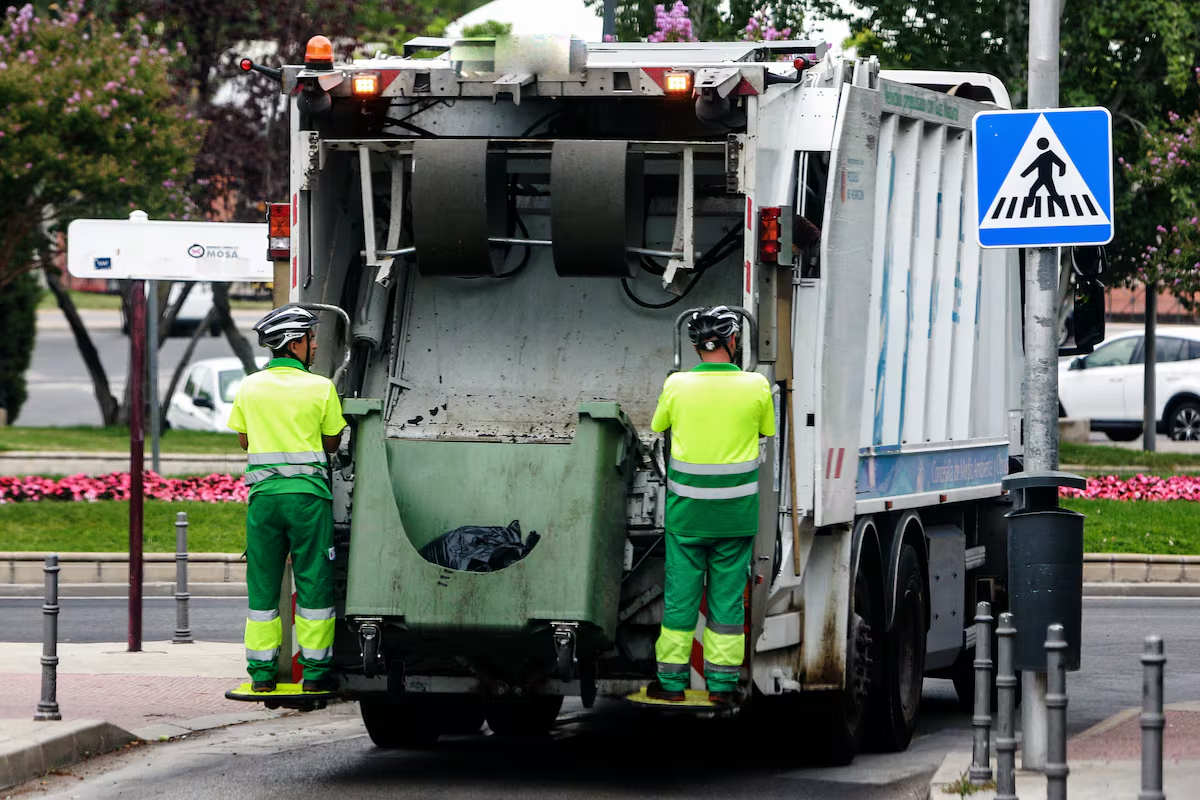
The National Association of Inspectors of Local Public Finances warned on Tuesday that the mandatory implementation of the new waste tax in Spain has opened a financial crack that would exceed 2,000 million euros in municipal budgets in 2025. Data managed by several private bodies, echoed by the inspectors ahead of their annual congress, indicate that the expected expenditure on waste management in the country amounts to 5,325 million euros, while the revenue of the new tax reach just 3,488 million. The gap reflects a coverage of 65.5%, which is far from the legal mandate that the rate must not be in deficit.
This obligation, introduced by state law 7/2022, has overturned a model that for decades combined taxes and duties to absorb the costs of the service and which now requires the taxpayer to bear 100% of the expense. This means that, explained Juan Ignacio Gomar, member of the association’s expert committee, if the legal mandate were to be fulfilled, the average tariffs approved by the councils could become even more expensive, to the point of adding that 2 billion deficit to the budget.
According to the expert, who worked on the White Paper that the association will present this week, the state regulation “introduced an article with the obligation for municipalities to establish the rate” and this change has generated “insecurity and great inequality among taxpayers”. Gomar points out that the amounts paid vary drastically between some municipalities and others and warns that “some tariffs will be canceled, which will generate very significant budget holes.” If local businesses collect the tax for several years and the court later invalidates it, the financial impact can be enormous. “In three or four years we could have municipalities that will have to repay many millions of euros.”
The problem is exacerbated where there has never been a garbage rate and it appears suddenly. In the municipalities that already provided for it, there has been a sometimes abrupt increase which in some cases exceeds 200 euros per home. According to Gomar, the increase in tax pressure is “extraordinary”, especially because residents do not perceive a real change in service. “If before the municipalities were able to finance management and care, now this rate makes citizens nervous because they don’t understand why,” he summarizes.
The expert recalls that the European directive provides for the transfer of waste treatment costs to taxpayers, but does not require the imposition of a specific rate, much less a non-deficit rate. Each state can choose the mechanism to achieve environmental objectives and only Spain has opted for the most drastic formula, he underlines.
The result is a technical and legal uncertainty that is transferred to each municipal council. The obligation to apply the payment per generation principle, according to which those who produce more waste pay more, is one of the great sources of conflict and an open door to litigation. “How do you calculate what each neighbor or property generates?” says Gomar.
In large cities, where the volume and diversity of waste is greater, individual measurement is extremely complex. City ordinances are developing disparate criteria to approximate this calculation, which opens up enormous challenges. Rulings issued by autonomous Superior Courts may differ from each other and the Supreme Court has not yet established doctrine on many of the aspects discussed. “It will be like a capital gain,” summarizes Gomar, referring to the constitutional ruling that declared illegal the old calculation of the tax that taxes the increase in value of urban land.
Arturo Delgado, president of the association, believes that the situation is the result of “years, decades, of neglect by the legislator” of the local treasury. It should be noted that the waste tariff was approved with “deficient and poor regulation which creates many problems” and that the mandate not to be deficient has caused a sudden impact on municipal financing.
Delgado recalls that Spain acted on the European Commission’s recommendation to establish tools to achieve environmental objectives, but that the decision to impose a mandatory tariff for all municipalities was adopted “in a simple paragraph” and without proportionate or elaborate regulatory development, leaving the technical details to the discretion of each council. The result, the inspectors assure, has been an economic burden hastily transferred to both municipalities and citizens, with consequences that already translate into thousands of hours of technical work and which, predictably, will trigger disputes.